

Introduction
When evaluating ERP systems like SAP Business One, NetSuite, or Microsoft Dynamics, the sales demos all start to look identical. Every platform claims it can handle your accounting, manage your warehouse, and track your sales pipeline.
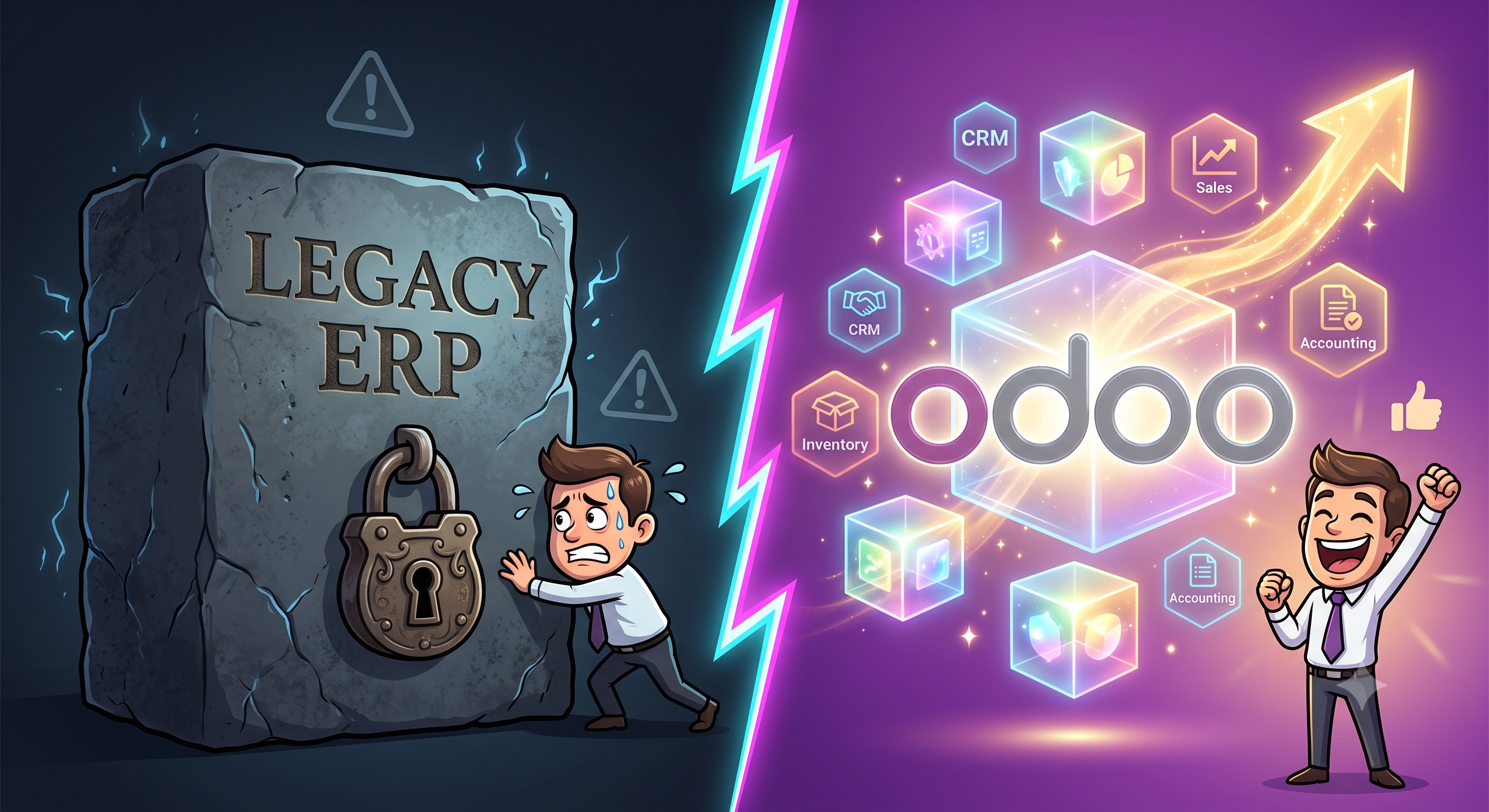
If you choose an ERP based purely on a feature checklist, you are missing the most critical factor: architecture. Legacy ERP systems were engineered decades ago. They are rigid monoliths designed for predictable, slow-moving corporate structures.
Odoo was built for modern, iterative business growth. It doesn't just offer the same features as legacy systems; it delivers them through a fundamentally different software architecture that eliminates the typical bottlenecks of corporate software. Let's look at the four unique structural advantages Odoo holds over traditional ERP platforms.
1. True modular scalability vs. the monolithic trap
With traditional ERPs, implementation is an all-or-nothing commitment. If you buy NetSuite, you are deploying a massive, complex engine from day one. Even if you only need accounting and inventory right now, the entire monolithic system must be configured, which drives up initial implementation timelines and costs.
Odoo uses a hyper-modular architecture. Every function (CRM, Helpdesk, Manufacturing, Quality Control, Invoicing) is a standalone app that natively hooks into the central ecosystem. You can install exactly what you need this week, and activate additional modules next year with a single click.
This modular approach means you don't overwhelm your team with features they don't need yet, allowing for a phased, low-risk rollout that traditional ERPs simply cannot support.
2. Customization without the 'Upgrade Lock'
Every business has unique workflows that require software customization. In legacy systems, customizing code is dangerous. Traditional platforms often hardcode modifications into the core system layer. When the ERP vendor releases a security update or a new version, your custom code breaks. As a result, companies get 'upgrade-locked,' staying on outdated, vulnerable software versions for years because upgrading would cost tens of thousands of dollars in redevelopment.
Odoo completely solves this via its unique inheritance mechanism. Custom modules don't overwrite core source code; they layer on top of it as independent extensions. When Odoo upgrades from version 17 to version 18, the core engine updates seamlessly underneath, leaving your custom application layers entirely intact. You get a fully customized system without sacrificing future upgradability.
3. A unified data layer vs. patched acquisitions
Many large ERP vendors grow by buying out smaller software companies and stitching them into their core platform. For example, a legacy giant might buy a standalone warehouse management tool, rebrand it, and sell it as an integrated module. But underneath the hood, that module runs on a completely separate database framework, requiring constant backend data synchronization.
Odoo is entirely organic. Every single one of its 40+ core applications was built by the exact same development team using the exact same framework and PostgreSQL database structure. There are no webhooks, APIs, or data sync schedules running between your CRM, manufacturing floor, and accounting ledger. A data update in one app is instantly live across the entire system globally because they all read from the exact same table.
4. Licensing that doesn't penalize your growth
Legacy ERP pricing is notoriously complex and restrictive. You are often billed based on the number of modules you use, your data volume, your transaction count, and the specific role access of each user. If your business grows and you want to open a new warehouse or add a customer service team, your software licensing costs can skyrocket unpredictably.
Odoo Enterprise simplifies this completely with its flat, all-apps-included user pricing structure. One predictable fee per user gives your team unrestricted access to every single module in the Odoo ecosystem. You are free to scale your operational footprint, add new departments, and activate complex tools without ever having to renegotiate your software contract.
The structural verdict
Choosing an ERP isn't just about what the software can do today; it's about how easily the software can evolve tomorrow. Legacy systems force your business processes to bend to the will of their rigid, unyielding infrastructure. Odoo does the opposite: it provides a robust, modern framework that adapts completely to how your business actually runs.
What to do next
The biggest mistake companies make is choosing an ERP based on a salesperson's slide deck rather than an architectural evaluation. If you are trying to figure out whether Odoo is the right fit to replace your current systems, you don't need a long, drawn-out sales pitch.
We help businesses run deep architectural audits to see exactly how Odoo will map to their current workflows. Let's hop on a single, focused two-hour scoping call. No fluff, no obligations, just a clear, technical look at how Odoo compares to your existing setup and what a realistic migration plan looks like.
Ready to move past spreadsheets?
Book a free 30-minute scoping call. We will map what you need and give you a clear implementation plan.
Get free consultation →