

Introduction
When you started your business, choosing software was simple. You picked HubSpot because the CRM looked clean. You signed up for QuickBooks because your accountant requested it. You added Shopify for ecommerce, Monday.com for project tracking, and a couple of specialized tools to manage inventory.
Individually, every single one of these choices made sense. They are excellent point solutions. But as your transaction volume grows and your team scales, these independent applications begin to resemble a digital Frankenstein, a monster stitched together by fragile API connectors, third-party automation tools, and manual data entry.
Growth has a way of turning a collection of handy apps into a massive operational bottleneck. Here is why trying to sustain a fragmented tech stack is quietly costing your business more than a centralized ERP ever would.
Anatomy of a Frankenstein stack (A real-world timeline)
Nobody sets out to build a messy tech stack intentionally. It happens organically as a business grows. Let's look at how a typical mid-sized business reaches this breaking point:
- Year 1 (The Foundation): You launch with Shopify for sales and QuickBooks for accounting. Life is good. Data entry is minimal.
- Year 2 (The Sales Push): You hire a sales team. They need a CRM to track leads, so you buy HubSpot. Now, you have to manually copy closed deals from HubSpot into Shopify or QuickBooks.
- Year 3 (The Warehouse Crisis): Your sales volume spikes. QuickBooks can't handle your advanced warehousing needs anymore, so you buy a dedicated Inventory Management System (IMS).
- Year 4 (The Glue): You realize none of these systems talk to each other. You hire a developer to build custom APIs, or you hook up Zapier to copy data automatically from HubSpot to the IMS, and then to Shopify, and finally to QuickBooks.
Suddenly, you aren't just running a business anymore. You are managing a complex software integration framework that requires constant maintenance.
1. You are paying a hidden "subscription tax"
On paper, a single point solution looks cheap. A few dollars per user here, a small monthly tier there. But when you tally up the monthly per-user costs across seven or eight separate platforms, the numbers quickly become alarming.
Consider the hidden overlapping costs. You pay for user seats in your CRM so the sales team can see client details, and then you pay for user seats in your accounting platform so the finance team can see the exact same customer data. You are paying multiple software vendors to store and display the exact same block of information.
When you calculate the total cost of ownership (TCO), including the cost of the apps, the cost of the automation tools required to connect them, and the developer hours spent maintaining those connections, the financial argument for a consolidated platform becomes undeniable.
2. The integration breaking point
To make a fragmented stack work, you rely heavily on automated 'handshakes' between applications. But software companies update their features, security protocols, and API structures constantly. When one vendor changes a single data field without warning, the entire chain breaks.
Imagine this real scenario: Your website platform updates its codebase overnight. The integration to your inventory management app fails. A customer orders a product that is actually out of stock. Your warehouse team doesn't find out until two days later, and your finance team has already generated an incorrect invoice in your accounting software.
Your employees now have to spend hours doing forensic data cleanup across three different systems. When your core operational data relies on external handshakes between competing software companies, your operational stability is completely out of your hands.
3. The fragmented data trap
When your data is scattered across multiple independent databases, you lose your single source of truth. Each department begins to live in its own operational bubble.
The sales team has one version of a customer's history in the CRM, the fulfillment team has a different version based on warehouse delivery logs, and the finance team has a third version in the ledger. Reconciling these differences requires massive manual effort at the end of every month.
Management meetings turn into arguments over whose spreadsheet or application has the correct metrics, rather than strategic discussions based on reliable data. You are effectively trying to steer your business looking through a fractured mirror.
The Odoo approach: Unified by design
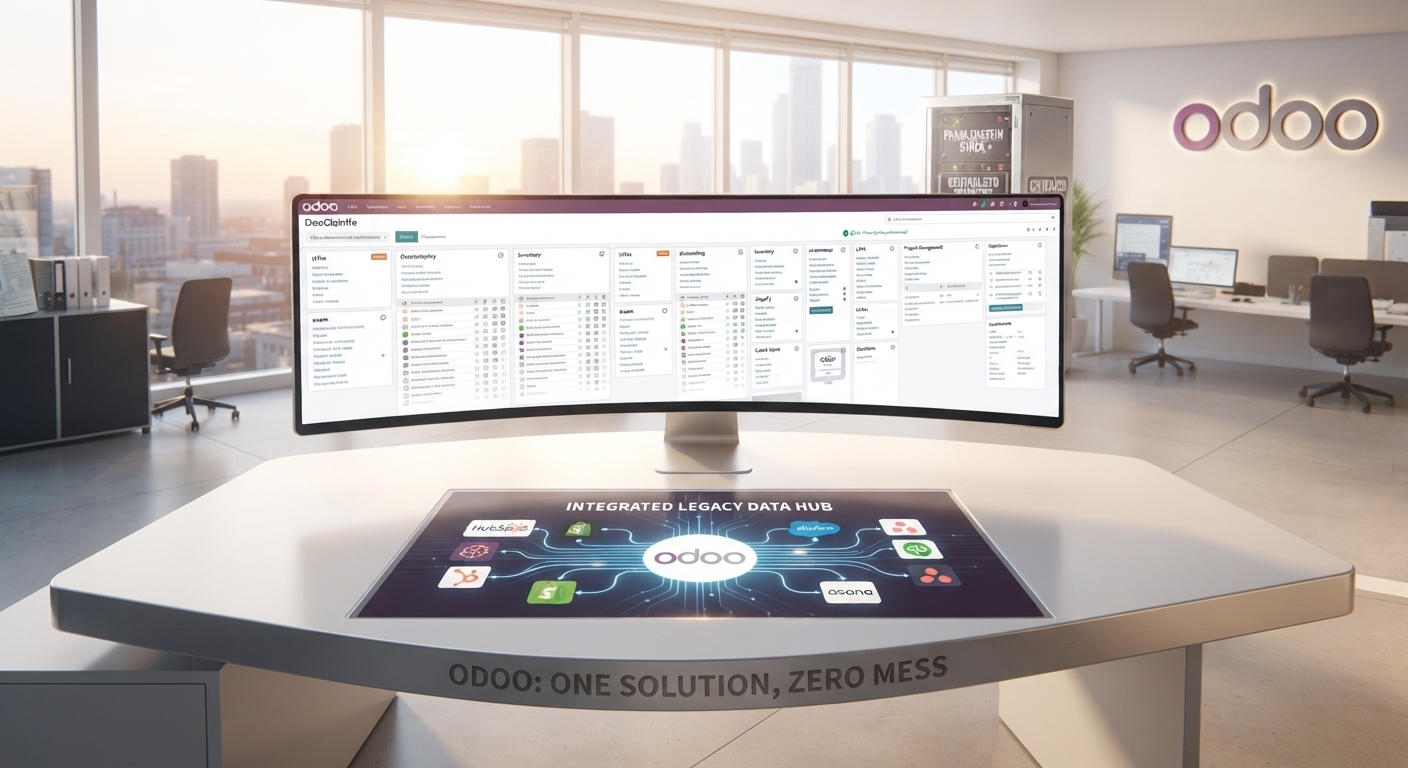
The alternative isn't just buying another piece of software; it's changing the architecture entirely. Odoo is designed from the ground up as a single, unified database environment. When you activate the CRM, Sales, Inventory, and Invoicing modules, they don't integrate with each other; they live in the exact same ecosystem naturally.
Let's look at the exact same transaction workflow in Odoo:
1. A salesperson confirms a deal inside the Odoo CRM module.
2. The Odoo Inventory module instantly reserves the stock in the correct warehouse aisle.
3. Odoo Accounting automatically generates a draft invoice for the finance team based on the agreed sales terms.
No data syncing, no Zapier triggers, no API calls, and zero risk of a connection breaking mid-transaction. It is one database, one login, and one clear picture of your business.
What to do next
Consolidating a software stack doesn't require tearing down your entire operational flow overnight. In fact, doing that usually causes more chaos. The most successful transitions happen in calculated, manageable phases, replacing your most painful operational bottleneck first before migrating the rest of your business.
We help growing businesses map out their current software ecosystem, identify the architectural bottlenecks, and map out the cleanest path toward software consolidation in a single two-hour scoping call. No sales pressure, no generic pitches, just a clear roadmap detailing exactly what you can eliminate, what you should keep, and what an optimized Odoo ecosystem will look like for your bottom line.
Ready to move past spreadsheets?
Book a free 30-minute scoping call. We will map what you need and give you a clear implementation plan.
Get free consultation →